Run it Backward to See the Future

To Infinity...

and Beyond

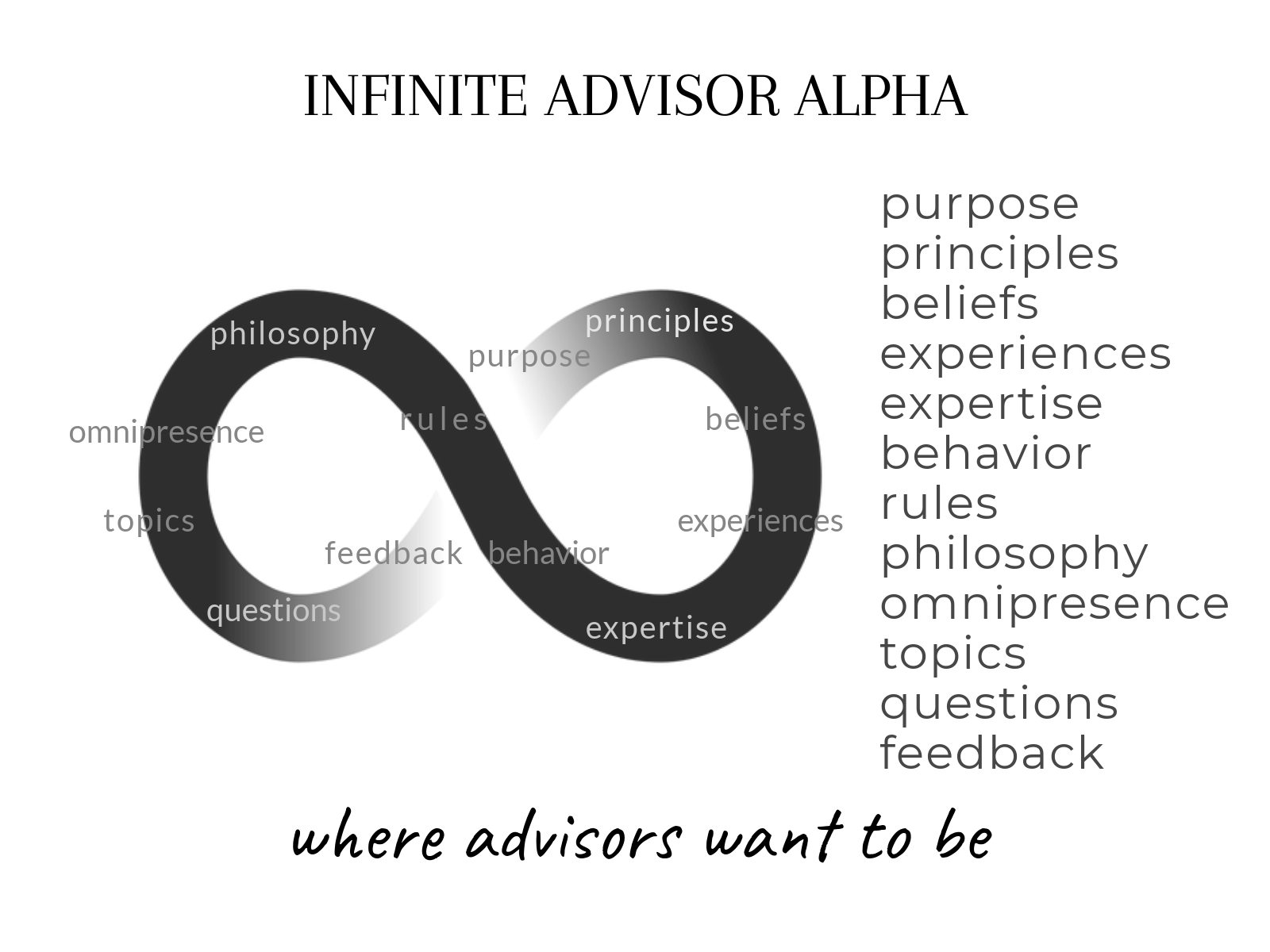
A look backward through the infinite alpha progression so you can see why it’s so critical, and how it will help you move forward in perpetuity.


Perspective

Looking at your business from the same perspective can be messed up sometimes… I mean, what other perspective can you possibly have?

Taking the word of a third party to help you rethink your value is a scary proposition. No one really knows what the hell is going on with Google and your marketing analytics are changing all the time. Why should you waste another minute working on your business when you need to be working in your business? If you aren’t growing, you are dying and you have to gather net new everything everyday before the sun goes down. The real things that have to actually happen are far different than the scenarios broadcast by marketing experts and self-proclaimed gurus. To get you through the day I have designed a simple progression that helps advisors create focus, amplify their discipline and helps them design their own system for success.


I am not a guru. I did design this progression to help advisors remain relevant in a robo-world.


The Disciplines From Back To Front

You need open honest feedback from trusted partner clients to survive in a robo-world.

To gather feedback that matters you must be armed with better questions.

To design the best questions you must have targeted topics that lead to your unique value.

Your value must become available 24/7 to convey your unique topical solutions.

Before you become omnipresent your philosophy and processes must have clear definitions.

There are rules that must be designed by you that qualify who gets to experience your value.

You must promise your behavior to expect reciprocal actions by your clients.

Your expertise must be defined by you and you alone and it is indelibly tied to your promised behavior.

The experiences you have gone through must become documented to create valuable touchpoints that tie to your accountability.

Your beliefs and opinions must be documented as the genuine concern and fundamental truths that guide your process.

Your principles and values must become more than an afterthought to earn the trust requisite for valuing your opinions and beliefs.

Your client-centered purpose is the cornerstone of the foundation that allows you the opportunity to make all of the aforementioned possible.


The best way for advisors to create a niche

Your Niche Is Out There

Why form a niche?

Why must you discover your niche? Not because it works… not because others have had success… because you can’t compete in the financial services industry on price. If you try, you will be replaced either by the industry, your firm or your clients. When the measure of your value is price alone, you become replaceable. You must become responsible for the ownership of the perception of your value. In doing so, you must find ideal like-minded clients to serve… because you can’t be all things to all people. Attempting to be a jack of all trades is the quickest way to be forced to exit this industry. Trust me when I say this, You don’t want to miss out on the next 10 years.


Clients that come to you for discounts will leave for discounts.


So you need a niche to remain relevant and become irreplaceable. Not because it may have worked for someone else.

1. You can’t compete on price.

2. You can’t be all things to all people.

3. Price becomes an issue in the absence of value.

4. Prescription without thorough diagnosis is malpractice.

5. Quality over quantity.

You must increase the quality of your clientele but you can’t afford to have your reputation tarnished by making promises you can’t keep. Your authentic value must be made available 24/7 for the world to see and here. This is not the corporate slogan or the company catchphrase… this begins with your client-centered purpose. You must own the words that define your authenticity and it all begins with your shared purpose. Ideal relationships are formed with a shared purpose… this is where you begin to carve out your niche.


To survive in the digital age advisors I must not compete on price… to thrive I must be able to increase the quality of my relationships by design. My process must become simplified yet productive. 


Your Process Must Empower You…

  • Connecting the dots of the critical components (simplification).
  • Building the foundation of your advisor alpha to create tangible value (exude value 24/7).
  • Expand tangible value to remain relevant and become irreplaceable (completing the process but never finishing).
  • Productive repetition by design (small steps).

You must get ideal clients…

you must remain relevant…

and you must become irreplaceable to keep ideal clients…

while you simultaneously expand the breadth and depth of your services 24/7.


Your niche can be formed by your purpose… in fact, it’s the only way to truly connect to your ideal audience in the new digital era of financial services.


Quality relationships begin with shared purpose.


I will pay you to solve my problems if you can prove to me that our end-game is mutual success.

~ Ideal Client

Relevance

Advisor Survival

I don’t want to be left behind. I must expand the boundaries of my declared expertise or risk becoming irrelevant.

How am I going to do that?


The fact is, my clients come to me for more than my expertise

It begins with my shared purpose. That’s why I do so well… my common driving force empowers me to do well personally while I am doing the right thing for my clients. How can I expand my limits of expertise by shifting my purpose without losing the flock?

Still, there are more components of my value than my expertise and purpose that must shift slightly for me to remain relevant over time.

More than simply my expertise grounded by purpose, my value is authenticated by my beliefs and opinions. The reason people pay me is rooted deeply in my beliefs and opinions which are developed through my experiences in business as well as life in general.

There are other characteristics of my value that my ideal clients are seeking…


The values that I hold close to my heart… the principles that construct my moral fiber are a huge component of my business. People trust me because they share the moral standards that I have developed through my life experiences and my business experiences. When they see me, they see themselves… or at least the closest version of themselves available, qualified and dedicated to one thing and one thing alone…the stewardship of their wealth.

So I want to remain relevant in an industry that is moving at light speed (exponentially faster every day). How do I make the shift?

If I exit the boundaries of my proclaimed shared purpose too abruptly I risk the mutiny of my clients. My shift in purpose must be quantified by me through honest and poignant client feedback… and it must be done at the new speed of business.  


How do I gather the metrics that matter to me so I can remain relevant?

What questions do I need to be asking my clients?

What are the topics of conversations I should be having with potential and current clients?

What content should I be publishing to keep my clients at ease?

How can I shift my expertise, subtly, to remain relevant without scaring away my client base?  

Man… I’m asking a lot of great questions today.

#TangibleAlpha

Adapt and Survive

My Advantage

It’s very important that you are able to challenge yourself to think differently on a daily basis so that you can remain adaptable to the ever-changing landscape of financial services. It’s equally as important to be able to challenge yourself in a 100% confidential platform. No one is looking over your shoulder, no one is judging you. This is the opportunity for you to take complete control of your business. Build on purpose at TangibleAlpha.com It truly is nobody’s business but yours.

Curated Article

Last week in Newport, Rhode Island I was reminded of what a healthy and robust economy we’re currently living in.

On a quiet Tuesday night, the restaurant we dined at, The Mooring, was anything but quiet. There wasn’t an empty seat in the place. We saw tables turned over multiple times and a constant lineup of eager diners with no reservations anxiously hoping a spot would open for them.

Nearly every great restaurant was experiencing the same. In fact, if a business didn’t have this type of demand, we could make an argument they were likely doing something wrong. As one person at my meeting said, “It’s almost hard to NOT to succeed in this market.”

That restaurant reminded me of one of the “classic” questions from the marketing world: If I were to ask you, what’s the single most valuable competitive advantage a company can have, what would you say?

Some would answer by saying money, or proprietary technology, or a monopoly.

The late Gary Halbert, a famous, contrarian direct response copywriter often wrote that the single most important competitive advantage any business could have was a “starving crowd.”

Halbert argued that the only competitive advantage you needed was an audience, hungry and salivating for your products and services. These restaurants were getting it right.

I love Gary and have often talked about him in my Tidbits, podcast, and while working with clients.

But in this case, Gary was wrong.

Sure, a metaphorically hungry, starving crowd is important, and many businesses have done a fantastic job cultivating that type of audience, but what about the rest of the companies out there?

What about companies facing industry-wide disruption from the Amazons of the world?

My friend and colleague, Colleen Francis, who consults for some of the biggest firms in the Fortune 100 suggested the single biggest threat she sees all clients facing, in nearly every sector, is literally Amazon.

She calls the phenomenon the “Amazonification of Sales.” Colleen says that clients in every sector and every industry now expect the Amazon experience. They’re going online and price shopping. They expect fast turnaround times and speedy delivery. And they expect it, regardless of what you’re selling – even if you’re selling a 2 billion dollar piece of heavy manufacturing equipment, or making a multi-million dollar licensing sale.

I see this outside the Fortune 100 and in my privately-held midmarket clients all the time. They’re all facing customers and clients with exceedingly increased expectations almost solely because of their experiences with Amazon.

And this is why Gary was wrong. The single most important competitive advantage a business has isn’t a starving crowd.

It’s the ability and willingness to change.

It’s getting harder and harder to win with “what got you here.” The strategies and successes of your past can, if you’re not careful, create your downfall. (Consider Blockbuster passing up on buying Netflix).

As one of my colleagues said last week which I thought was brilliant, “If it can happen to #generalelectric, it can happen to you. Nobody is immune.”

So here’s a question for you to consider.

Are you experimenting with enough change?

None of us have even a smidgen of the resources available to Amazon, but it doesn’t mean we can’t be changing at a similar speed.

For example, Amazon, Google, Apple and others are famously known in business circles for innovating through small teams and constant micro-experiments running all the time.

What experiments are you running in your business?

What processes are you engaged in changing or improving?

What can you change about your sales process, your customer experience, your decision-making process, etc?

There’s enormous pressure in the business world to optimize for results today. But the magic lies in optimizing for today while innovating for tomorrow. Excellent management can balance those objectives carefully.

Your Challenge For The Week: Devise a low-risk experiment you can run for a short time and share it with me.

Here are a few examples.

If you’re a VP of Sales, consider a new step or reducing steps in your sales process.

If you’re in charge of #customerservice, devise a new way of handling complaints, criticism, and feedback.

If you’re in charge of #customerexperience, consider testing something new as part of the customer’s post-purchase experience, or try testing a new way of caring for customers in a retail environment.

If you often launch new products into the market, try pre-selling those products before launching them.

The key is to make your experiments low-risk, and low-stakes, but enough to help you change, pivot, adapt, remain relevant, and thrive well into the future.

As a bonus challenge: Ask all your subordinates (VP Sales, CMO, CFO, etc.) to make a list of all the processes, tasks, and repetitive things the company does on a regular basis. If you asked why they’re done in a certain way, and the response is, “Well, that’s the way we’ve always done it….”

Start there.

Original Article Link